

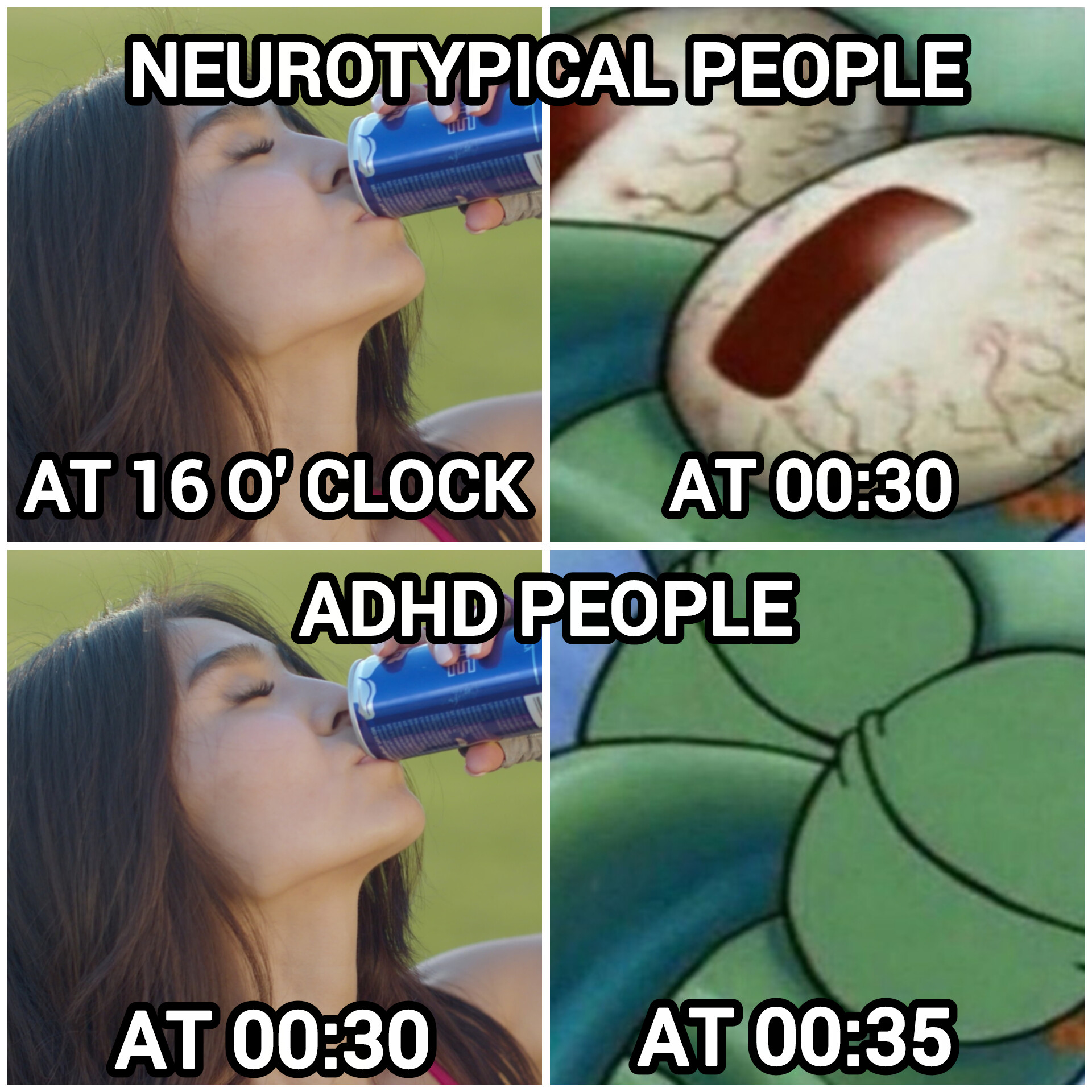
Disclaimer: of course, everything is a spectrum. To ADHD-people, caffeine has varying effects. Some get tired from it, others it affects less or not at all.
Disclaimer: of course, everything is a spectrum. To ADHD-people, caffeine has varying effects. Some get tired from it, others it affects less or not at all.
Do you guys say “16 o’clock?” I’m used to the 24h tube since I live in Japan, but I find myself always going back to 12h like I did in Canada where I grew up. So saying 16 o’clock in English sounds a bit unnatural for me. But I also have no problem saying 16 heure in French. Old habits die hard I guess.
I’m from English speaking Canada and I’m doubling down on 24h and metric.
Where I am I’ll write 16:00 and read it aloud as “4 o’clock”
I say “sechzehn Uhr” but drop the “Uhr” when adding Minutes (“sechzehn dreißig” for 16:30), except before 13:00 (“neun Uhr” for 09:00 and “neun Uhr dreißig” for 09:30) because it flows more easily. But some people keep the “Uhr” even after 13:00 (it’s the official way).
Written standard though is to put “Uhr” behind all the numbers (“neun Uhr dreißig” is written as “09:30 Uhr”).
16 hours is the “official”/military way to say it
16 hours is mostly an American military way to say it. 16 on the clock (or similar for different languages) is the main European way to say it.
Well, we’d say 4 o clock… But that’s English too. Have considered how the rest of Europe says it?
I have to confess that I do not know how every European language says it, but I do know that both German and Danish say and write the equivalent of “o’ clock/on the clock”, eg. “Klokken, Uhr”.
The only time I’ve seen “x hours” used, is either in programming, that abomination that is “military time”, or when defining time from now, eg. “Let’s meet in 4 hours, at 20 on the clock”.