

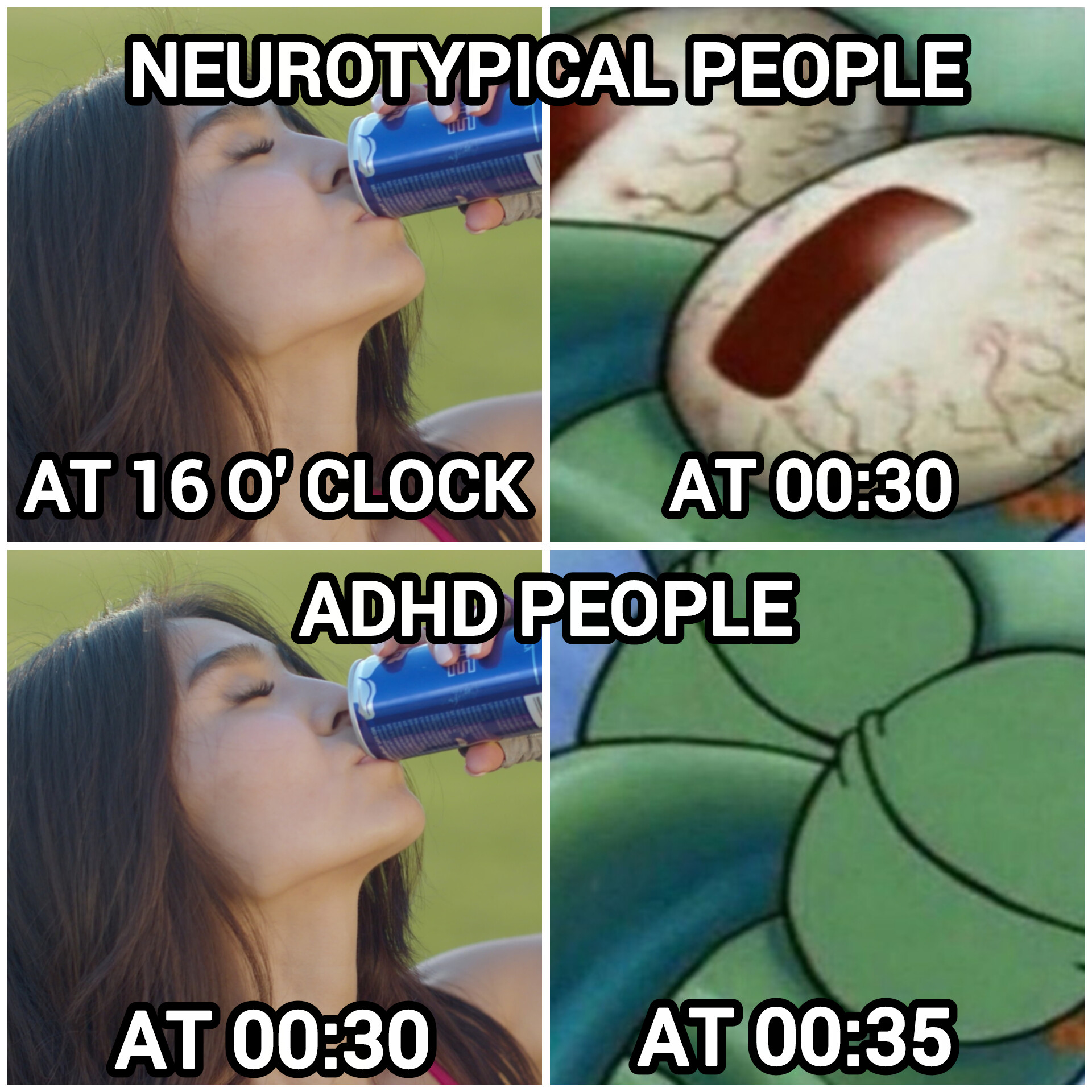
Disclaimer: of course, everything is a spectrum. To ADHD-people, caffeine has varying effects. Some get tired from it, others it affects less or not at all.
Disclaimer: of course, everything is a spectrum. To ADHD-people, caffeine has varying effects. Some get tired from it, others it affects less or not at all.
Where in the world is it standardized to write times like that?
Europe I guess? We like 24h time
This is not true for all of Europe however!
Do you guys say “16 o’clock?” I’m used to the 24h tube since I live in Japan, but I find myself always going back to 12h like I did in Canada where I grew up. So saying 16 o’clock in English sounds a bit unnatural for me. But I also have no problem saying 16 heure in French. Old habits die hard I guess.
I say “sechzehn Uhr” but drop the “Uhr” when adding Minutes (“sechzehn dreißig” for 16:30), except before 13:00 (“neun Uhr” for 09:00 and “neun Uhr dreißig” for 09:30) because it flows more easily. But some people keep the “Uhr” even after 13:00 (it’s the official way).
Written standard though is to put “Uhr” behind all the numbers (“neun Uhr dreißig” is written as “09:30 Uhr”).
Where I am I’ll write 16:00 and read it aloud as “4 o’clock”
That’s my preferred method as well. I like 24 hr time for writing but I’d never say it out loud, May e bc I didn’t grow up saying it.
I’m from English speaking Canada and I’m doubling down on 24h and metric.
16 hours is the “official”/military way to say it
Actually, the military way to say that would be “sixteen hundred hours”. 4:30PM would be “sixteen thirty hours”. You always specify the minutes, even when it’s zero minutes, which is notated by saying “hundred” for the double-zero.
As a math nerd, this bothers me way more than it should. The reason we say “hundred” when we read a base-ten number that ends with two zeros is because that is the place value of the final non-zero digit–it is literally one hundred times the number you’ve already read aloud. But in the military time version, a) the hours are not hundreds of minutes, they’re groups of sixty minutes, and b) it’s groups of minutes, not hours, so the units also get messed up. If someone tells you it’s currently 0 hours and you should meet again at 800 hours, logic would suggest they’re asking you to go away for more than a month, but in fact they’re saying 8 hours, despite the difference being apparently 800 hours.
I’m aware how pedantic this is, and I’m perfectly capable of understanding what they mean because I’ve heard it so often in movies and whatnot. But I swear these stupid games with units contribute to keeping us dumb.
16 hours is mostly an American military way to say it. 16 on the clock (or similar for different languages) is the main European way to say it.
Well, we’d say 4 o clock… But that’s English too. Have considered how the rest of Europe says it?
I have to confess that I do not know how every European language says it, but I do know that both German and Danish say and write the equivalent of “o’ clock/on the clock”, eg. “Klokken, Uhr”.
The only time I’ve seen “x hours” used, is either in programming, that abomination that is “military time”, or when defining time from now, eg. “Let’s meet in 4 hours, at 20 on the clock”.
16’o’clock is still weird AF.
Look at them europeans bragging about their ability to count beyond 12 hours!
/s (I’m european too, I find it funny that people get confused with 24h time format)
Its not the 24 hr time, its saying it with “o clock” that’s weird
1435 hours AM
O’clock is pretty british. HH:MM is normal in the more civilised areas of Europe (aka the rest of Europe).
Generally O’Clock is used with a 12 hour clock and AM/PM is implied by context, if you need specificity use millitary time (i.e 24 hr clock - 1600). As an Australian I find 16 O’Clock a bit jarring.
First of, in Europe we use ISO 8601, which is quite different from the military time which the USA uses.
Second, in my home country we still say “16 on the clock” or “15:45 on the clock” (just translated to the native language, eg. “Klokken 16”) to signify we’re talking time and not weight or distance.
You said
I was speaking to that (Australia is very similar).
I’m from Europe. I use a 24h-clock but not military time. Military time is an anglophone thing I don’t care about since I’m not in the military. And frankly, I don’t care much about how Australians or US-Americans or English people find my time and date formats or any other unit or measurement jarring, because you guys rarely agree on any kind of measurements, so I use metrics, a 24h-clock (maybe add an “o’clock” because it reads nicer to me) and dd.mm.yy(yy) instead of stones, pounds, feet or freedoms per square ketchup ¯\_(ツ)_/¯
Whatever, you do you. We’re 100% metric btw.
Canada, UK and USA aren’t, at least not in colloquial language. That’s what I mean. You post something in english and always meet someone from some anglophone country doing it differently. So I stopped caring.
So what’s wrong with kg for weighing things, st & lb for people, miles for driving distance, metres for building things, C for temperature and feet for ascent of hills and stuff? That’s what a 70’s born UK kid thinks like. So 16:15 is said out loud, quarter past four, maybe rarely 1615, but never 16 o’clock and? No. O’clock is only on the hour. If it’s got bits on the end you say everything except the ‘o’clock’ But I love what you’ve done with ‘half-four’ to mean 3.30. I really enjoy doing that with my German colleagues.
What’s right about it?
That’s not exclusively german though as germanic languages in general and some slavic languages use this format.
military time is NOT 24 hour time! Stop mixing the two.
military time doesn’t use minutes and hours but rather merges the two - 16:45 becomes 1645, and so on.
24 hour time still distincts minutes and hours.
100% this. I was going to post what you said as well. But I will add that in the US, if you use 24 hour time, most people just refer to it as military time. If you tell them the difference they don’t really care.
In the US 24h is virtually never used in a civil context, but in scientific, engineering, and medical contexts it is ubiquitous.
Valid, but hardly deserving of significant argument. Actually considered that in my original post but decided that it gets the point across. I now regret the whole thing, ppl take it way too seriously.
Peace, out.
TV time and military time don’t even use 24 hours. You can have a TV show that goes from 23:30 to 25:15 (25>24, in 24h it would be 01:15).
I imagine those who call 24h “military time” also say “I’ll be home from work on Friday at 4100 AM”, which makes about the same amount of sense.